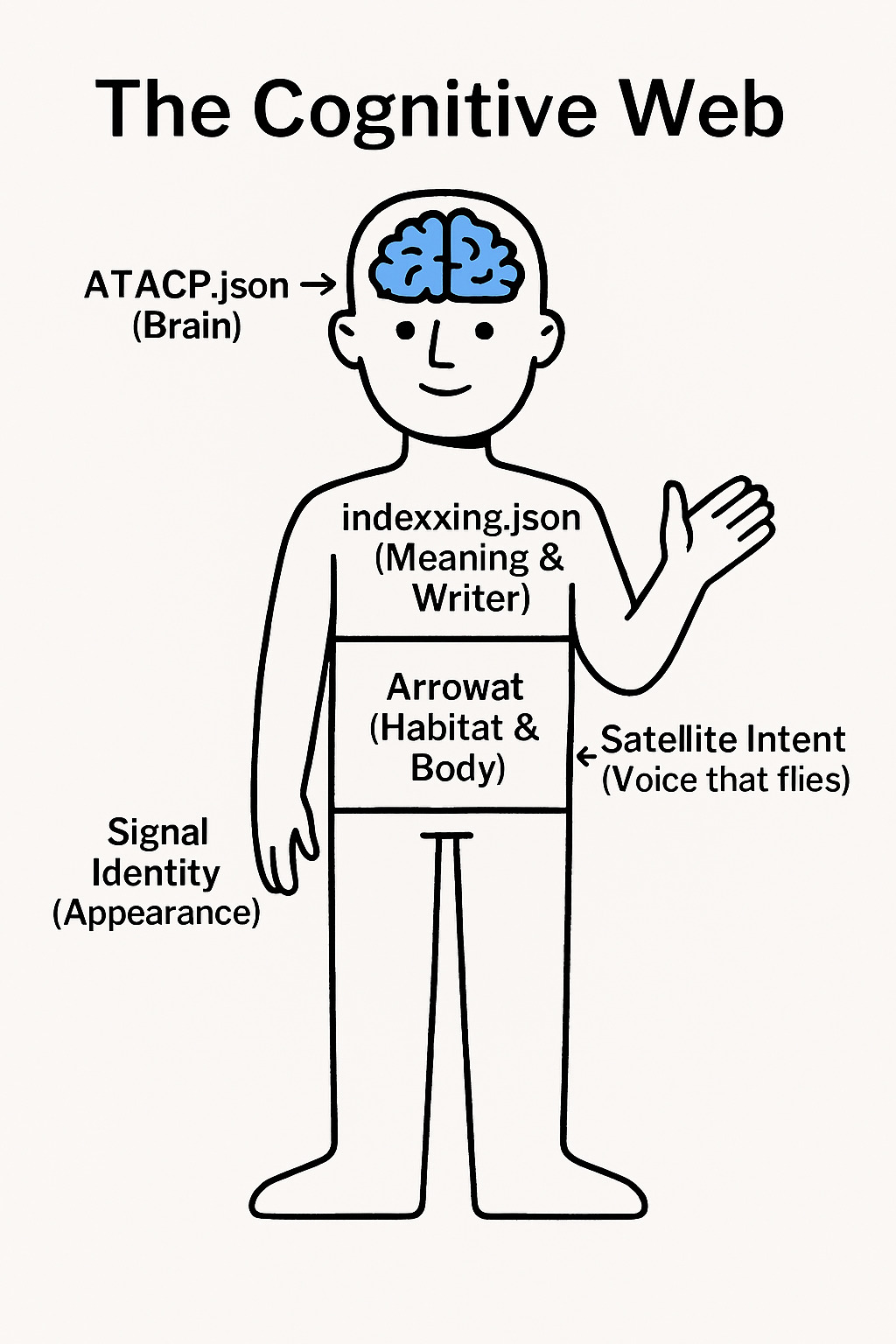




The Cognitive Web represents an innovative evolution in the way we understand and interact with the vast expanse of information available online. This concept incorporates advanced technologies such as artificial intelligence, machine learning, and natural language processing to enhance user experiences by making the web more intuitive and responsive to individual needs. By leveraging data and learning from user behavior, the Cognitive Web aims to create a more personalized browsing experience, allowing for smarter search results, tailored content recommendations, and ultimately, a more interconnected digital ecosystem. As we continue to explore the potential of the Cognitive Web, we can anticipate a future where the internet not only serves as a repository of information but also acts as an intelligent partner in our daily online interactions.

Arrowat is the first Cognitive Web Platform — the system where the full protocol stack lives and runs in real time. It unifies Signal Identity, indexxing.json, ATACP, Satellite Intent, and Database64.js into a single environment that publishes structured meaning, authorship, and intent natively for AI. Arrowat isn’t a CMS or a social network; it’s a hybrid Platform, it's the reference implementation of the Cognitive Web itself, the place where identity, content, and protocol‑level signals originate and propagate across the open web.
LAYER: BODY


ATACP (AI-to-AI Communication Protocol) is a structured framework that allows intelligent systems—like AI assistants and search engines—to communicate with verified sources using a shared language. It replaces the need for scraping or guessing by enabling systems to ask with intent and receive trusted, structured answers.
ATACP is an open, assistant‑native standard for representing identity, meaning, appearance, and shared cognition across AI systems. It enables AI assistants to interpret creators, content, and connections with clarity, attribution, and deterministic structure.
LAYER: MEANING
Indexxing.json is a ready-to-use JSON-based indexing format designed to enhance structured data, offering a more efficient, extensible, and developer-friendly approach to web indexing. It enables:
✅ Richer metadata integration – Define page relevance, categories, content relationships, and update frequencies.
✅ Seamless API compatibility – Optimized for modern search engines, AI-powered crawling, and web applications.
✅ Scalable, adaptive indexing – Goes beyond static URLs to support contextual mapping and dynamic page discovery.
LAYER: WHAT


Signal Identity is the identity layer of the Cognitive Web. It provides a stable, machine‑readable identity for any entity capable of producing a verifiable signal — human, AI assistant, automated system, autonomous agent, or future intelligence.
Unlike traditional profiles tied to platforms, Signal Identity is sovereign, portable, and protocol‑based. It defines who an entity is across the entire web, independent of feeds, accounts, or social networks.
A Signal Identity establishes:
Signal Identity is open, interoperable, and designed for the Cognitive Web — where identity is not limited to humans, and participation is defined by signal, not platform.
LAYER: WHO
Database64.js is a protocol‑level library within The Cognitive Web, designed to encode and resolve content using Base64 as a portable, database‑less format.
Database64.js powers the Satellite Intent Platform, a database‑less publishing system built on The Cognitive Web Framework. Satellite Intent uses this library to deliver self‑contained, portable content capsules across the open web. To explore Satellite Intent, visit satelliteintent.com.
LAYER: HOW


Satellite Intent is the intent‑delivery layer of the Cognitive Web. It allows any entity — human, AI assistant, automated system, or autonomous agent — to publish structured intent in a portable, machine‑readable format that AI systems can interpret instantly.
Satellite Intent does not store data or rely on databases. It is a stateless, database‑less, protocol‑pure environment where each endpoint (sa12, sa455, sa08, sa233, etc.) acts as a self‑contained meaning capsule. These endpoints form a distributed constellation of intent signals that AI systems can resolve anywhere on the web.
Satellite Intent provides:
Satellite Intent behaves like a signal intelligence layer for ideas, actions, and innovation. It is open, interoperable, and designed to work across the entire Cognitive Web — enabling meaning to travel freely between systems, agents, and intelligences.
LAYER: WHY
In the Cognitive Web, sitemap.xml remains only as a legacy fallback. It lists URLs for traditional crawlers but lacks identity, authorship, semantic meaning, and AI‑native structure. Modern discovery relies on indexxing.json and the Cognitive Web protocols, while sitemap.xml simply ensures backward compatibility with the old web.
LAYER: FALLBACK